The worry
Too many therapists, no one connecting the dots
Physio on Monday, speech on Thursday, a psychologist somewhere in between — and you’re the one holding it all together.
Rehabilitation for life after Stroke, Parkinson’s, Brain Injury, Spinal Cord Injury, Multiple Sclerosis, Dementia, Cerebral Palsy.
One dedicated Care Navigator to bring together your loved one’s physio, speech, cognitive, occupational and psychological therapy — into a single plan that works at home.

 Senior specialists from the Indian Federation of NeuroRehab
 Built with IIT Kanpur under a BIRAC grant, Department of Biotechnology, Government of India
Sounds familiar?
Physio on Monday, speech on Thursday, a psychologist somewhere in between — and you’re the one holding it all together.
One person coordinates every therapist, appointment and update — and your Care Circle keeps the whole family in the loop.
The Manastik way
One navigator. One plan. One team that talks to each other — so you can go back to being family.
In person and online
Eight areas of care, coordinated by senior specialists from the Indian Federation of NeuroRehab (opens in a new tab).
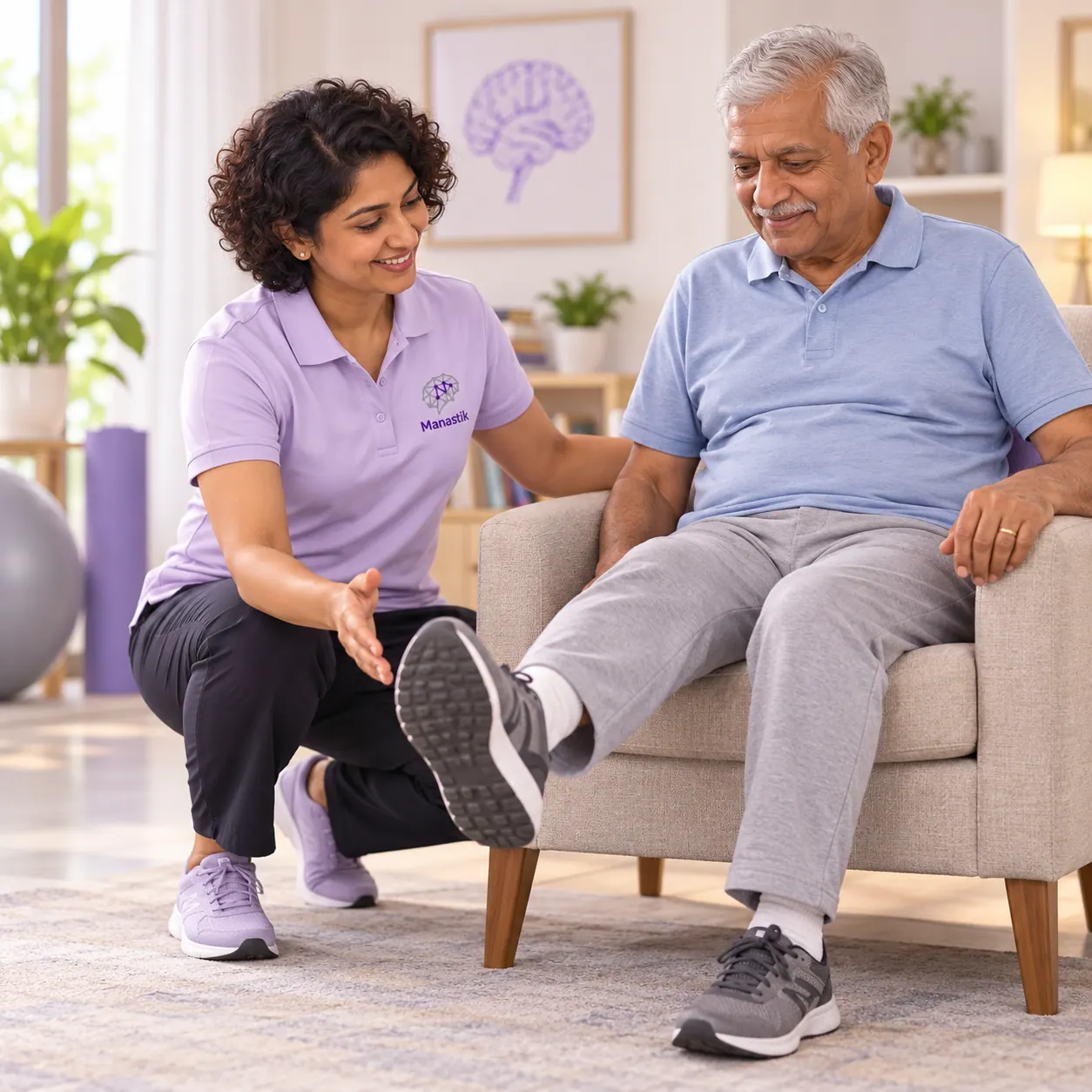
Neuro physiotherapist
Walking, balance, strength and posture — rebuilt step by step, with exercises that carry over into everyday life at home.
How it works
Step 01 · Understand
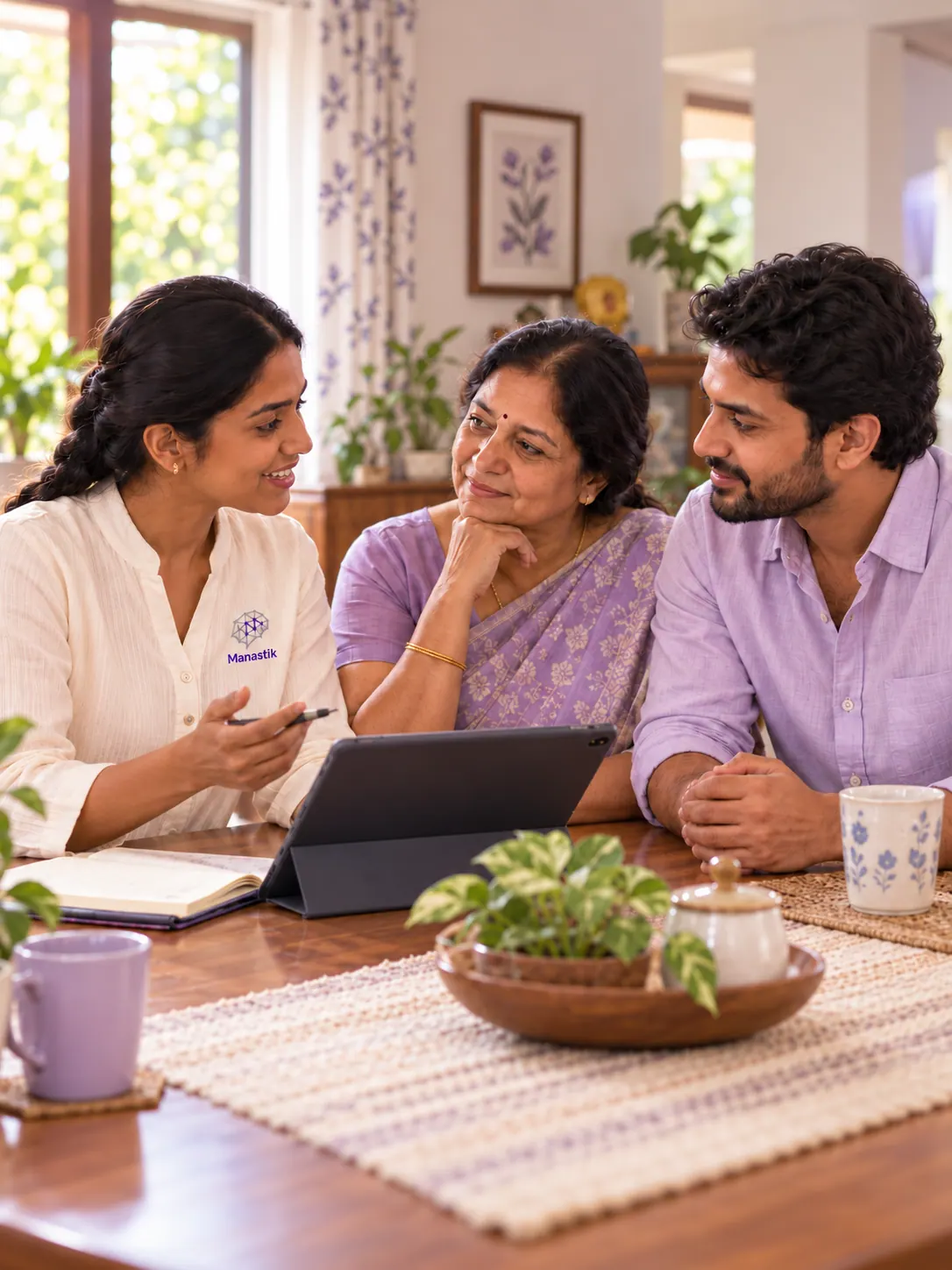
Your family joins the care circle from day one.
What the evidence says
Manastik’s care pathways are guided by senior clinicians of the Indian Federation of NeuroRehabilitation (IFNR) — including Prof. (Dr.) Nirmal Surya, President-elect of the World Federation for NeuroRehabilitation, and Dr. Abhishek Srivastava, India’s first PhD in Neurological Rehabilitation from NIMHANS. Manastik has also signed an MoU with NIMHANS to support India’s first government-led brain health programme.
In the Copenhagen Stroke Study of 1,197 people, 80% reached their best level of daily-living function within 6 weeks of a stroke, and 95% within 12.5 weeks.
The brain is most adaptable early on. Research in animal models shows a time-limited window of heightened neuroplasticity opens after a stroke, during which the greatest gains in recovery occur. Murphy TH & Corbett D. Nat Rev Neurosci 2009 (opens in a new tab)
Recovery is fastest in the first 10 weeks. The passage of time alone explained 16–42% of the improvement seen in the first 6 to 10 weeks after a stroke. Kwakkel G et al. Stroke 2006 (opens in a new tab)
Practice is the dose. Across 312 observed therapy sessions, people practised an average of only 32 task-specific arm movements per session — likely too few to drive the brain’s rewiring on their own. Lang CE et al. Arch Phys Med Rehabil 2009 (opens in a new tab)
More therapy time, better recovery. In a meta-analysis of stroke rehabilitation trials, more time in therapy predicted greater improvement. Lohse KR et al. Stroke 2014 (opens in a new tab)
Online therapy holds its own. Telerehabilitation showed no difference from in-person therapy on daily activities, balance and arm function after stroke. Laver KE et al. Cochrane Database Syst Rev 2020 (opens in a new tab)
Key takeaway: start neurorehabilitation as soon as the medical team says it is safe, practise every day at home between sessions, and keep going — the early months matter most, but it is never simply “too late” to improve.
The people
Our clinical advisors shape how every Manastik plan is built, delivered and reviewed.
Recognition & collaborations
 BIRAC BIG GrantSIIC, IIT Kanpur
 Best Stroke InnovatorYoung Investigator of the Year
 NIDHI EiR Award
 Imperial College London
 MOU Signed with NIMHANS
 Indian Academy of Neurology
 WFNR mentorship
 National Mission on CPS
 iHeal 4.0
 BIOME Fellowship
Showcased globally at
 2022ASEAN Startup FestivalIndonesia
 2023AOSNR CongressThailand
 2024World Stroke CongressAbu Dhabi
 2025RehabWeekChicago, USA
 2026World Congress for NeuroRehabilitationDaegu, South Korea
Care Navigator

Questions families ask
Home neuro physiotherapy can begin even while your father is still in bed. A neuro physiotherapist assesses him at home first, then starts with safe positioning, assisted movement and sitting balance.
No, it is not too late. Recovery is fastest in the first three months, when neuroplasticity is highest, but many people keep improving long after that with focused, repetitive practice.
Yes. Online speech and language therapy works well for many people with aphasia after a stroke, especially when a family member helps set up the video call.
A Care Navigator is your single point of contact for the whole rehabilitation plan. They understand your family’s needs, connect you with the right therapists and keep everyone working towards the same goals.
Neurorehabilitation is a team approach for conditions of the brain, spinal cord and nerves; physiotherapy is one part of it. It treats movement, speech, thinking, mood and daily living together.